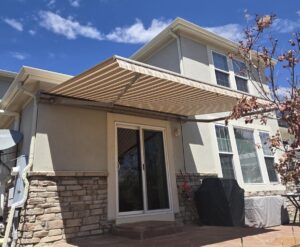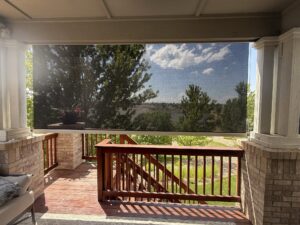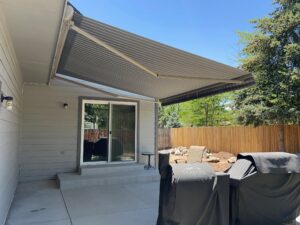

A retractable awning is a significant architectural addition to your home, and the value of that investment is defined by how well the system adapts to your specific environment. In the Front Range, where a calm morning can turn into a high-wind afternoon or a blistering heatwave, the features you choose are what transform a standard shade into a high-performance home extension.
When planning a Colorado patio transformation, it is important to look beyond the basic aesthetics. The following features represent the “bones” of a modern awning system, determining everything from its lifespan in Colorado winters to how much it actually reduces your indoor cooling costs.
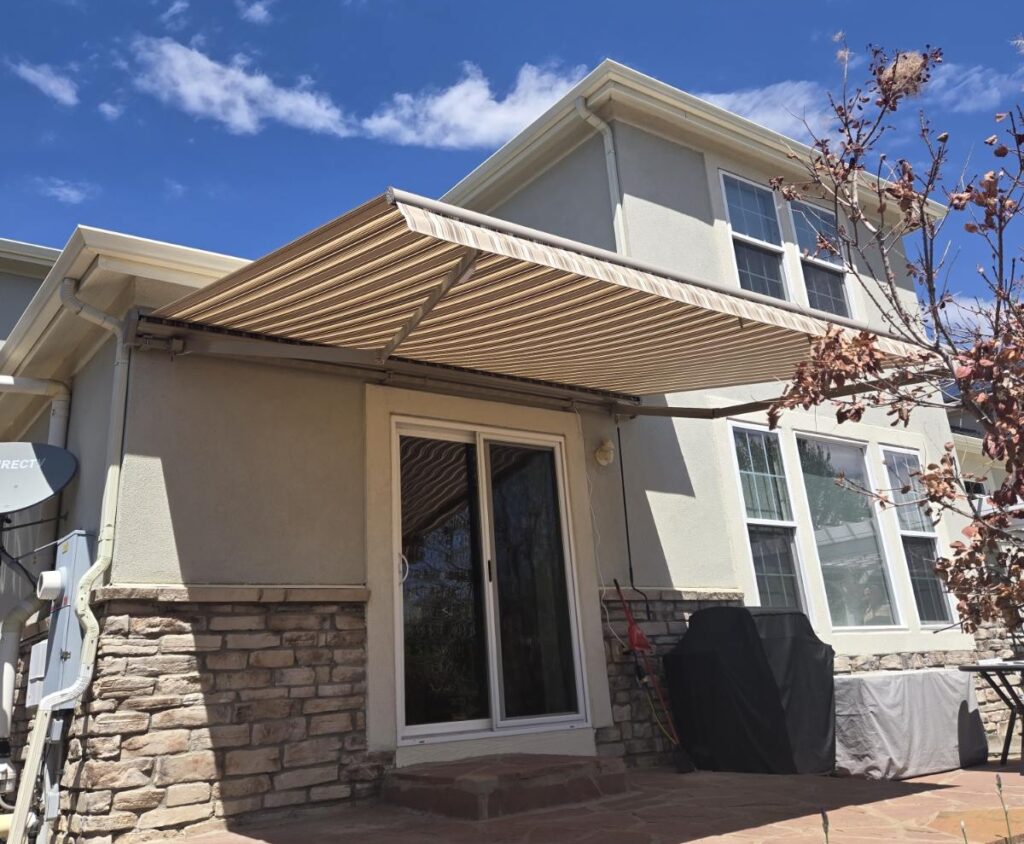
Retractable Awning Cassette Housing Options
The “housing” is the protective enclosure that stores the fabric and motor when the system is retracted. Choosing the right housing is less about style and more about protecting your investment from the debris, nesting birds, and freezing rain common in the Denver metro area.
Open Roll: This is the most traditional and budget-friendly option. The fabric roll remains visible and exposed to the elements even when retracted. While functional, it requires more frequent cleaning and leaves the fabric vulnerable to “top-down” weathering from snow and UV exposure.
Semi-Cassette: A semi-cassette system features a protective “hood” that covers the top of the fabric roll. This shields the material from rain and bird droppings while leaving the folding arms exposed underneath. It’s a middle-ground solution for homes with some existing overhead protection, like a deep eave.
Full Cassette Housing: For a Colorado awning company, this is the gold standard. When retracted, the folding arms and the fabric roll are completely enclosed in a powder-coated aluminum casing. This prevents ice from forming inside the mechanism and protects the fabric from “UV rot” while stored. It ensures your system lasts 15+ years by keeping the most sensitive mechanical parts away from the harsh Front Range winters.
Choosing the Right Awning Fabric
Selecting a fabric is a functional decision that impacts the thermal comfort of your entire home. We utilize Premium Sunbrella® Fabrics not just for their hundreds of color options, but for their high-altitude performance and resistance to fading.
The color you choose dictates the “light environment” of your patio. Darker fabrics, such as charcoal, navy, or black, are exceptionally efficient at absorbing heat and killing glare. If your patio faces West and you struggle with the blinding afternoon sun, a dark fabric provides immediate visual relief. Conversely, lighter fabrics reflect more solar energy, keeping the area beneath the awning slightly cooler, though they allow more ambient “glow” to pass through. Choosing the right weight and color ensures your patio doesn’t just look better, but actually feels 20° cooler.
Automated Wireless Wind Sensors
Wind is the primary enemy of any retractable structure. In areas like Douglas County or the foothills, wind gusts can pick up without warning. An Automated Wireless Wind Sensor serves as a digital insurance policy for your home.
These sensors are mounted directly to the lead bar of the awning. They don’t just “guess” the wind speed; they measure the actual vibration and “chatter” of the system. If the wind reaches a threshold that could threaten the structural integrity of the mounting brackets or the arms, the sensor triggers the motor to retract the awning automatically. This feature is essential for homeowners who want the freedom to leave their awning extended without worrying about a sudden Front Range weather shift while they are away from the house.
Integrated LED Lighting and Evening Usability
One of the most overlooked aspects of an awning is how it functions after the sun goes down. Without integrated lighting, a patio can feel dark and disconnected from the house once evening hits.
By choosing Integrated Dimmable LED Lighting, which is built directly into the support arms of the awning, you fundamentally change how you use the space. It transitions your patio from a daytime haven from the heat into a sophisticated “outdoor room” for evening dinner parties and relaxation. Because the lights are integrated, there are no messy power cords or “party lights” to get tangled in the folding arms, maintaining a clean, professional look that enhances your home’s nighttime curb appeal.
EZ-Pitch Adjustments for Shifting Sun Angles
The sun doesn’t stay in one place, so your shade shouldn’t either. Most standard awnings are bolted into a fixed position, but EZ-Pitch Adjustment allows you to manually raise or lower the front bar of the awning using a simple crank handle.
Homeowners often worry that adjusting a large mechanical system will be difficult or risk breaking the alignment. However, EZ-Pitch is designed for exactly that—user-friendly, incremental changes. This allows you to “track” the sun as it dips lower in the horizon during the afternoon, ensuring you have shade exactly where you need it without requiring a service technician to recalibrate the arms.
Front Drop Screens and Perimeter Privacy
While retractable awnings provide overhead protection, the EZ-Pitch adjustment works hand-in-hand with Front Drop Screens to handle the most difficult “low-angle” sun. These screens are integrated into the front bar (or valance) of the awning and can be lowered vertically.
These screens are particularly useful for Denver retractable awnings on westward-facing decks where the sun eventually sneaks in underneath the fabric. Furthermore, these screens act as a privacy barrier, blocking the view from neighbors while still allowing you to see out. It effectively “closes in” the space, giving you the feeling of a screened-in porch that can be fully retracted whenever you want to open up the view.
Wireless Motorization and Smart Home Integration
Modern Colorado awning installation almost always includes wireless motorization, but the “custom” aspect comes in how you control it.
Wireless Remote: The standard for ease of use, allowing you to stop the awning at any point to customize your shade coverage.
Smart Home Integration: Many systems can now be linked to your smartphone or voice-command systems like Alexa or Google Home. This allows you to set “schedules”—for example, having your awning extend at 2:00 PM to shade your south-facing windows before you get home from work.
Manual Override: This is a critical safety feature. In the event of a power outage during a storm, a manual override allows you to hand-crank the awning back into its protective housing, ensuring the system isn’t left vulnerable when the grid goes down.
Sizing and Strategic Placement for Indoor Cooling
When designing your system, the placement is just as important as the features. At Direct Awnings, we focus on the “Cooling Starts Outside” philosophy.
If your awning is wide enough to overlap your sliding glass doors and adjacent windows, it prevents solar heat gain from entering your home in the first place. By shading the “envelope” of your house, you can significantly reduce the load on your AC system. We look at the orientation of your home to determine the “shadow footprint” needed to keep both your patio and your living room cool.
Understanding Specialized Mounting Solutions
Every Colorado home is built differently, and a “one size fits all” mounting approach often leads to structural issues.
- Wall Mounts: The most common method, secured into the house studs or headers.
- Soffit Mounts: A “soffit” is the flat underside of your roof’s overhang or eaves. Mounting here allows the awning to be tucked up and out of the way, which is an excellent solution for homes with limited wall space.
- Roof Mounts: If your house has low eaves (common in many older Denver ranch-style homes), mounting to the wall would put the awning too low to walk under. In these cases, we use specialized, leak-proof brackets to mount the system directly to the roof rafters, providing the necessary height for head clearance and proper water runoff.
Bring It All Together to Enhance Your Outdoor Space
Choosing the right features for your retractable awning is about engineering a solution that fits the way you live. By combining protective housing, smart automation, and strategic placement, you create an outdoor space that is usable, comfortable, and durable enough to handle the Front Range for years to come.
The next step in reclaiming your outdoor space is a free estimate to determine the ideal mounting and sizing for your specific architecture.